Research
Rebuilding the transmit, gradient and receive chains of a magnetic resonance imaging system, from the electromagnetic design down to the FPGA.
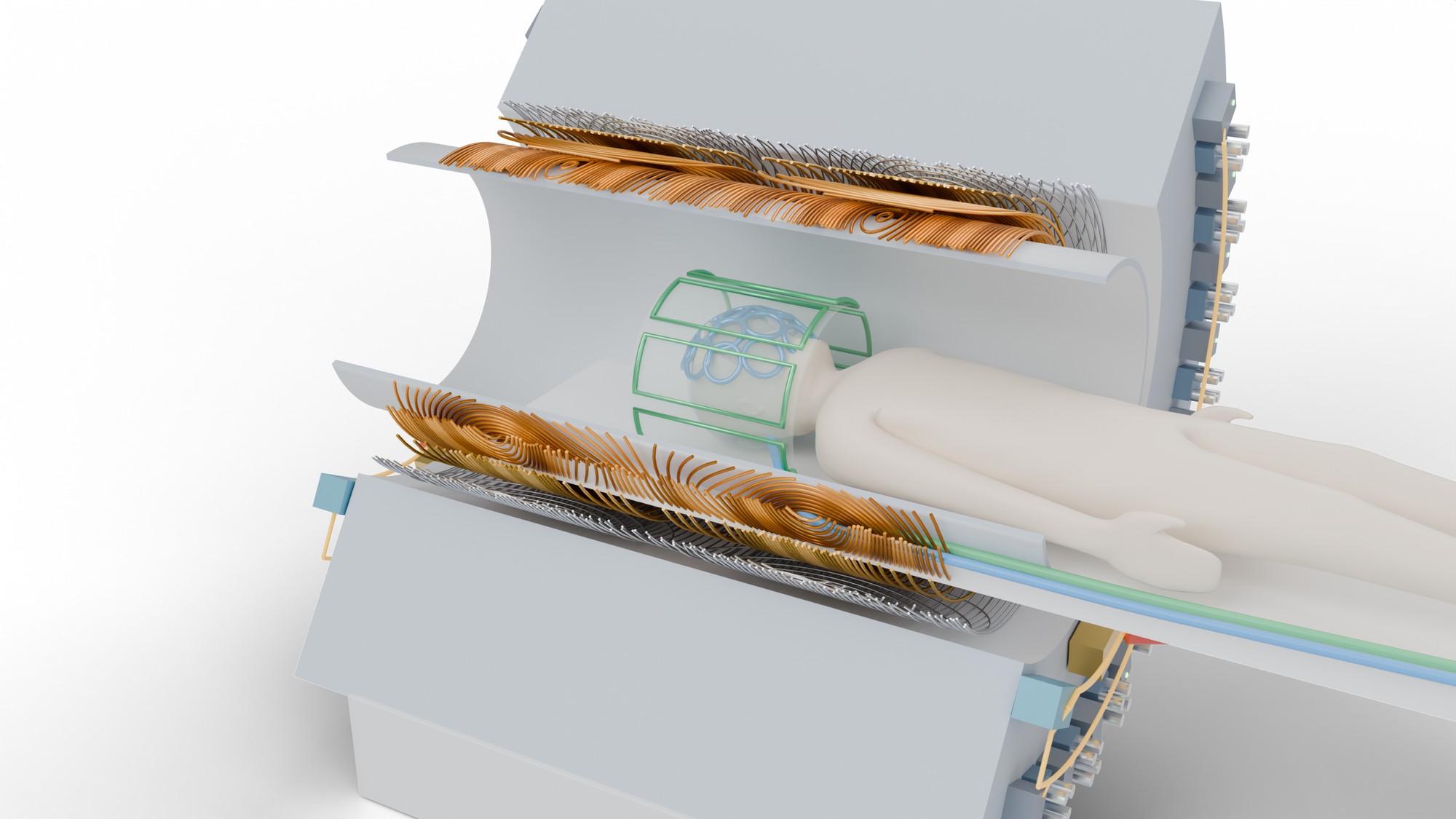
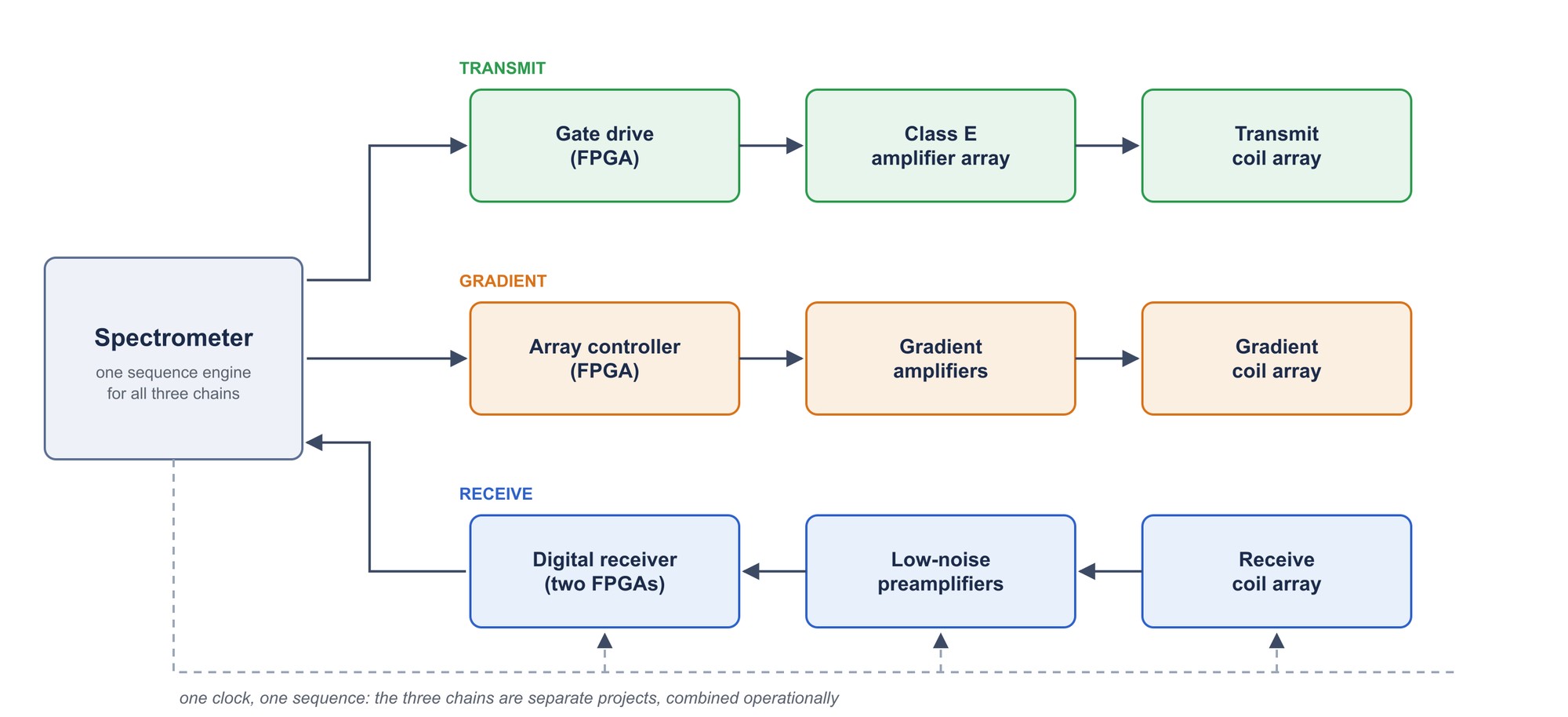
An MRI scanner is three chains of hardware working to one clock: a transmit chain that excites the spins, a gradient chain that encodes position, and a receive chain that recovers the signal. We are rebuilding all three, in our own laboratory, from the electromagnetics of the coil down to the register-transfer code in the FPGA.
The work divides naturally into a matrix. Each row is one of the three chains. Each column is a layer of engineering: the electromagnetic design that sets what is physically possible, the analog electronics that drive or amplify, the digital design that controls and captures, and the safety work that decides how hard any of it may be pushed with a person inside. Each of the twelve cells has its own people, its own instruments and its own open questions.
| Electromagnetic | Electronics | Digital design | Safety | |
|---|---|---|---|---|
| RF Receiver | Receive coils and sensitivity | Low-noise preamplifiers | The digital receiver | Receive coil safety |
| RF Transmitter | Transmit fields | Class E transmit array | Gate drive and array control | Power deposition and heating |
| Gradient System | Coil and array design | Gradient amplifiers | Gradient array controller | Nerve stimulation |
Common to the three chains: The spectrometer
Technical notes: Designing a shielded gradient set · The MR signal in units of the square root of power
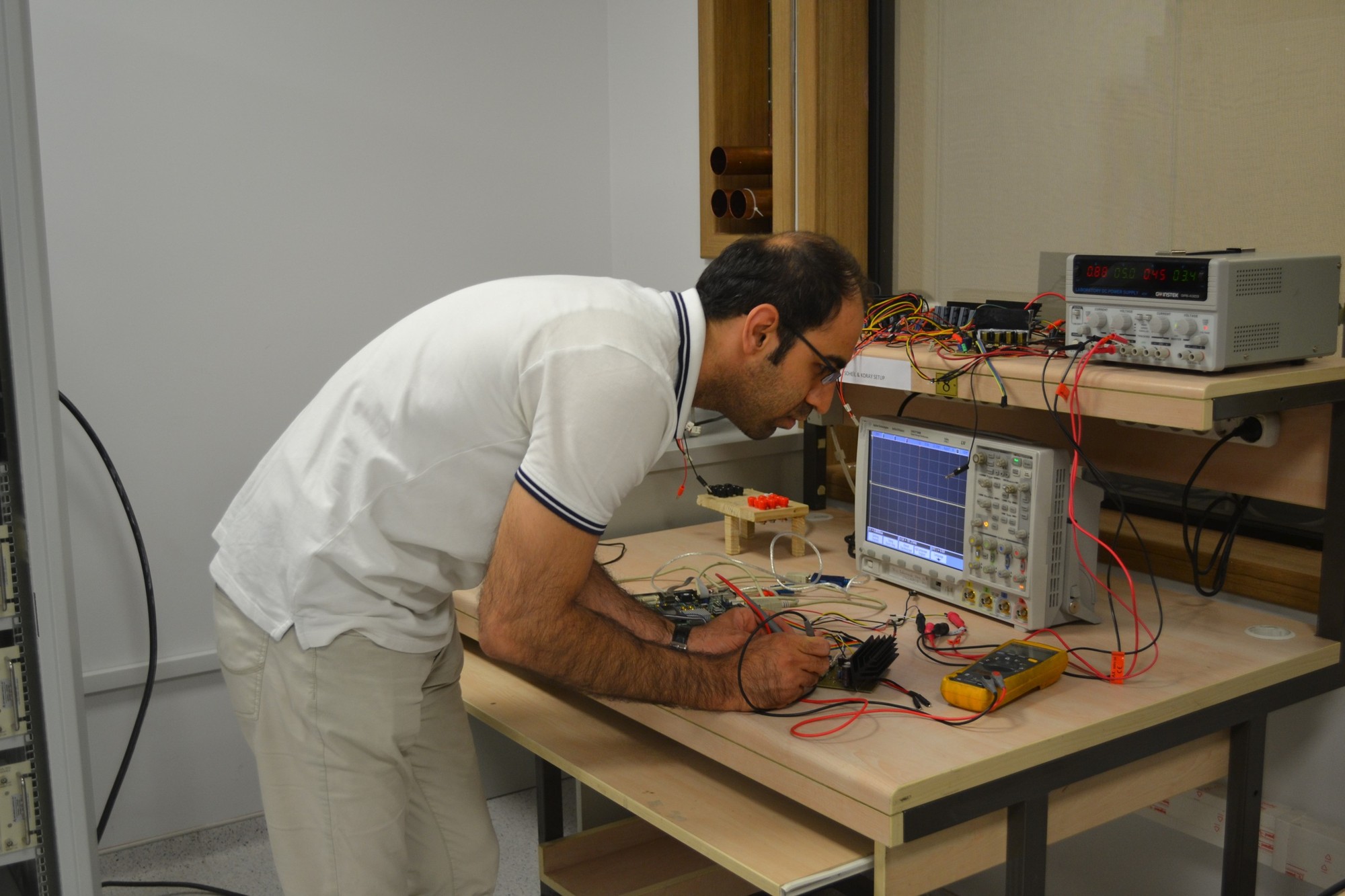
Safety is a column rather than a footnote. In magnetic resonance the limit on performance is usually not the hardware but the person inside it: the electric field the gradients induce in tissue, the power the transmit coil deposits, the heat a receive element can produce if it fails to detune. Those limits are what the first three columns are designed against, so they are studied with the same instruments and by the same people.
Why rebuild rather than buy
A commercial scanner is a closed instrument. Its encoding fields are fixed by the winding pattern at manufacture, its receive chain is sealed, and its pulse programmer exposes only what the vendor chose to expose. Every question we want to ask sits below that surface. Building the hardware is what makes the questions askable.
Funding
The work is carried by several projects at once, and no single project maps onto a single cell of the matrix. A coil design and the amplifier that drives it are usually funded differently, and a student paid by one project often works across two columns.
| Project | Programme | Subject |
|---|---|---|
| 125E832 | TUBITAK 1001 | Eddy currents, with gradient arrays. 2026–2029. |
| 23AG005 | TUBITAK 1004 | Neurotechnology Solutions Platform, Bilkent/UMRAM component. |
| 125C001 | TUBITAK 2247-B | Support for the European Research Council application. |
| 101078393 | EU Horizon | MRITwins. Partnership and exchange with European laboratories. |
Two further applications are under evaluation and are not listed here until there is an outcome.
What ties the twelve cells together
The three chains are separate projects with separate repositories, and they are combined operationally through a common spectrometer that acts as the sequence engine. The receiver, the transmitter and the gradient controller each present the same kind of interface to it.