Gradient System · Safety
The gradients cannot be switched as fast as the amplifiers allow. What stops them is the electric field they induce in the body, and that is a question of field geometry.
The question
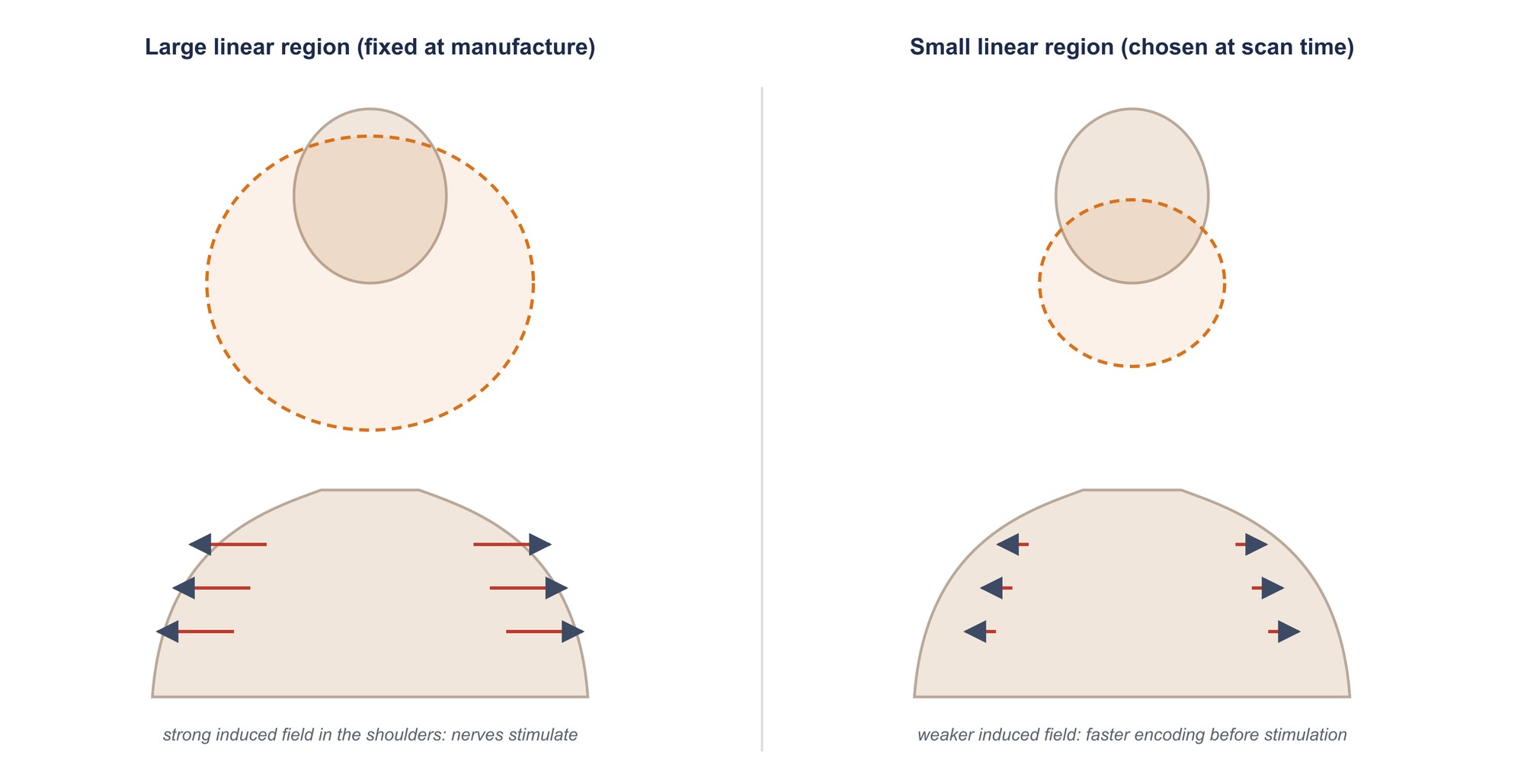
Switching a gradient induces an electric field in tissue. Push hard enough and that field stimulates peripheral nerves: the subject feels it, and the scan has to slow down. This, not the amplifier and not the coil, is what limits how fast an image can be encoded on a modern system.
The induced field depends on the geometry of the encoding field, and specifically on the size of the region over which the field is held linear. In a conventional coil that region is fixed at manufacture, so the stimulation limit is a property of the installed hardware and there is nothing to be done about it. If the coil is driven as an array, the region becomes a choice made at scan time, and the limit becomes a property of the operating point rather than of the machine. That is the central claim our gradient work is built around.
What follows from treating it this way
- Performance stops being a single pair of numbers, a maximum gradient and a slew rate, and becomes a reachable set traded off against field of view and induced electric field.
- The safety calculation moves into the pulse sequence, because the sequence now chooses the operating point.
- Other quantities join the same trade space: acoustic noise, dissipated power, and the forces on the coil.